"Zionist blood libel!" blare hundreds of posters pasted on walls lining the streets of Jerusalem's reclusive Jewish ultra-Orthodox neighbourhood of Mea Shearim.
In Jerusalem, on the front lines of the Middle East conflict, tensions not only run high between Israelis and Palestinians, but also across the deep divide between the authorities and ultra-Orthodox Jews, also known as Haredim.
Few people foresaw how opening a car park on the Sabbath and the arrest of an allegedly abusive ultra-Orthodox mother could spark some of the worst Jewish unrest the Holy City has seen in years.
The ultra-Orthodox community has long been ambiguous towards the Jewish state created in 1948, whose laws may sometimes come second to rabbinical rulings. Its most extreme sects vehemently oppose Israel's existence.
Rioting erupted last month after Jerusalem's secular Mayor Nir Barkat ordered the opening of a parking lot near the tourist-packed Old City on Saturdays, the traditional Jewish day of rest.
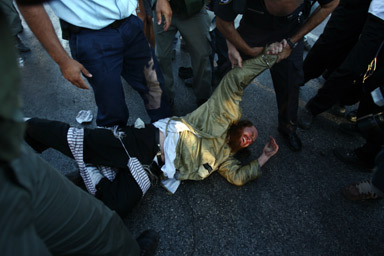
Prominent rabbis called for a mass mobilisation in protest at what they consider to be profaning the Sabbath, and for three straight weekends police clashed with thousands of stone- and nappy-throwing Haredim in and around Mea Shearim, bastion of the ultra-Orthodox community.
Just as tensions were seeming to ease after a compromise was reached, the Haredi community was further enraged over the arrest in mid-July of a woman suspected of starving her three-year-old son.
Police and state prosecutors allege that the mother, who they say is mentally ill, had deliberately starved the boy, who was taken for treatment at the Hadassah Ein Kerem hospital weighing a mere seven kilos (15 pounds).
The family, from the radical Toldot Aharon sect, says it had turned to the welfare services for help with the "sick" child, "after which the persecution immediately started", according to family spokesman Dudi Zilbershlag.
A picture of the flesh-and-bones toddler was leaked to the press and sent shockwaves across both the secular and Haredi societies, and the case has dominated Israeli news ever since.
Clashes quickly broke out in and around the narrow, crowded streets of the Haredi neighbourhood. Dustbins were set alight, traffic lights were smashed and black-clad protesters hurled rocks at police and municipal vehicles.
Police are pelted with stones and rubbish almost every time they enter Mea Shearim.
The case 'hurt every Haredi'
"The Zionist-Hadassah-police axis of evil is in the process of vilifying us. An organised blood libel!" screams one of the hundreds of posters on the walls known as Pashkevils which present rabbinical decisions to the faithful.
"The Hadassah hospital has declared war against the Haredim... dreadful stories of doctors' barbaric treatment of Haredi patients who fall like easy prey in their hands!" charges another.
Mea Shearim and adjacent Haredi neighbourhoods were abuzz with blame for the "Zionists", with Hadassah hospital doctors described as the enemies of Haredi Jews.
Doctors and other Hadassah staff received hundreds of telephone threats and were also verbally abused by irate protesters outside the medical centre on Jerusalem's outskirts.
The "starving mother", as she's been dubbed, has since been released under house arrest and is undergoing psychological treatment, but is still not allowed to see the boy.
Although she is from one of the most radical and closed ultra-Orthodox sects, the case touched a raw nerve within the entire community, which showed a rare unity in battling the authorities.
Zilbershlag says the case "hurt every Haredi in the country".
"The Haredi public considers this case a betrayal by the authorities that strengthens the conspiracy theory... I don't remember in the past 20 years such incitement against the ultra-Orthodox public," he says.
"The brunt of the responsibility for bringing up and educating the children in the ultra-Orthodox society lies with the mothers, and this is why the mother became so symbolic in the eyes of the public."
The Orthodox Jewish community makes up about one third of Jerusalem's entire 750,000-strong population.
"The police and the media are using the same methods used by the Nazis to show that the Haredim are violent and evil," according to Yosef, a 26-year-old Haredi who refused to give his full name.
"The Haredim are being persecuted. There is serious doubt whether the allegations are true," he says quietly, standing by a Pashkevil in the heart of Mea Shearim, sporting the traditional black hat and jacket and long sideburns.
Moishe Feldman, a reporter for Hakol Haharedi radio, says the case united the ultra-Orthodox because it touched on one of the few things the community's different and often rival sects agree on -- rejecting state involvement in what are perceived to be internal affairs.
"The Haredi rabbis said at all the rallies that "police will not teach us how to raise our children," says Feldman.
"Usually when there are severe cases of child abuse and other serious crimes, the Haredi community tries to resolve the issue without police involvement.
"This story turned into a general fight between the (Haredi) public and the welfare services, the Hadassah Ein Karem hospital... If we do not fight this case and prove that this is a blood libel, the Haredis say, then we will continue to suffer because of the authorities."