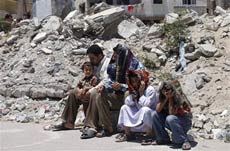
GAZA CITY — The gruesome moment can never go away from Wael al-Samuni's mind.
"They killed our children, our relatives," the 35-year-old Gazan father told Agence France-Presse (AFP) on Saturday, June 6.
"They destroyed our houses. Why? We don't know."
Samuni lost 29 relatives, including his son, daughter and mother, in a deadly Israeli attack in Gaza in January.
"We want to rebuild. As for the dead, may God watch over their souls," he said from a tent he calls home, filled with whatever belongings he could salvage.
The story of the Samuni family is one of the most heart-rending of the hundreds of tragic testimonies that emerged from the deadly Israeli offensive in Gaza.
The family was ordered by Israeli soldiers into a house in the Zeitoun neighborhood on the outskirts of Gaza City on January 5.
"The soldiers told us to stay there ... We were around 70 people there," said 12-year-old Mumina al-Samuni, who lost his brother, sister and grandmother in the strike.
In early morning, the building was struck by an Israeli shell.
"The two others came in the minutes that followed," he recalls.
"There was dust everywhere; we saw nothing. There were shouts and cries."
According to witnesses and human rights groups, the Israeli army did not allow rescue services and medics to reach the building for three days.
Israeli troops killed more than 1,400 people and wounded 5,545 in 22 days of massive attacks in Gaza in January.
UN investigators concluded a five-day finding mission in Gaza on Friday to look into Israeli war crimes in Gaza, home to 1.6 million people.
The 15-member commission, which is expected to present its conclusions in August, visited 40 sites and spoke to some 70 witnesses and relatives of victims, including members of the Samuni family.
Israel has refused to cooperate with the UN team, claiming it was based on a biased mandate.
"We had hoped to have public hearings in Gaza, in southern Israel and in the West Bank but because of the refusal by Israel to cooperate with the mission, we are not able to fulfill that hope," said Richard Goldstone, who leads the UN team.
"I Was Scared"
Yaqub al-Samuni shows a deep chest wound he sustained on the fateful day when he lost his mother and four brothers.
For three days after the Israeli strike, the 11-year-old remained trapped in the house, wounded and surrounded by his dead relatives.
"I was scared," he said, recalling the horrifying moment.
"There was blood everywhere. I was injured but it didn't hurt.
"I fed my young brother Ahmad, who was also injured. We ate pasta and tomatoes, but we had no water."
Salah al-Samuni, 30, was also in the house that day, but escaped unscathed.
He recalls how when he shouted at the Israeli soldiers that there were injured people inside, one of them yelled back in Arabic "go back to your dead!"
"Why the Israelis did it?," Samuni asked.
"We want justice, for the perpetrators to pay for the actions and for the victims' right to be recognized."
"We were all civilians," he said.
"For the injured children, something should be done. They need surgery, they need real medical treatment. There are no means here, and no-one cares about us."