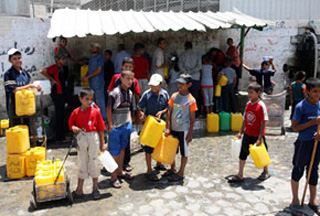
The latest war on Gaza and the Israeli policy of collective punishment have wreaked havoc on the water infrastructure in the strip.
Israel has enforced a 21-month blockade on the Gaza Strip and has managed to cripple the economy with its recent war that inflicted over $1.6 billion of harm on the Palestinians residing in the territory.
Since the war, however, the longstanding water crisis in Gaza has reached epidemic proportions with residents being forced to survive on water polluted with a high saline and nitrate concentration.
Some of those who have the luxury obtain their drinking water from desalination stations.
The very few who can afford to buy fresh drinkable water, buy it from supermarkets or private vehicles selling water.
In some remote areas, wells have been dug in a humanitarian effort that allows Gazans to get free water but only after standing in long lines for hours.
"The water we get from the tap is salty and unhygienic. That's why we buy drinking water from the nearby desalination station or vehicles selling water. Salty water causes skin and kidney diseases," a Gaza resident told Press TV correspondent Yousef Al-Helou.
The coastal aquifer -- dependant on rainfall -- provides 96% of all water consumed in the densely-populated sliver. According to the Gaza coastal municipality water utility company, the water shortage is due to Israeli wells around the Gaza Strip.
Israelis have pumping stations around the Gaza Strip that divert water before it reaches the aquifer. The flow of fresh water comes mainly from regions under Israeli control.
The prolonged Israeli siege has also been a source of tension as it has brought Gaza water wells to a standstill at a time that the water infrastructure is in desperate need of an upgrade.
Due to the closure of border crossings, however, Gazans are not able to receive the materials necessary to make improvements.
"We need spare parts for water facilities. We have around 250 generators in need of maintenance and repair," Majid Ghannam, the quality manger at the water utility, explained.
"Power outage is another problem we have to face. Sterilization chemicals such as chlorine, necessary to make water fit for human consumption, are also in short supply," he continued.
While there is no solution in sight for the current predicament, water specialists generally agree the situation is such that 85% of the 150 water wells in Gaza are not suitable for drinking.