After the September 11 attacks, the image of the Muslim world became extremely distorted and overnight all Muslims became terrorists related to the Al-Qaeda network, according to many westerners. Not all, however. Led by an inspiring vision and a profound understanding of the need to live in peace and show another vision of real Islamic teachings, Taran Davis, an English-American film producer, is working to restore some balance.
Davis, who comes from a Christian (Church of England) background, was helped by many people who believed in the clarity of his vision to transmit a genuine and authentic idea of the real Islam in a film about the life of Ibn Battuta, the great Islamic explorer. After being shown in New York, Detroit, Paris, Toronto and Abu Dhabi, the film has finally come to Kuwait, with the Kuwaiti premier of 'The Journey to Mecca: In the Footsteps of Ibn Battuta,' being held at the Scientific Center on Tuesday night.
Minister of Amiri Diwan Affairs Sheikh Nasser Sabah Al-Ahmad Al-Sabah patronized the premier of the film, deputizing for His Highness Sheikh Nasser Al-Mohammed Al-Sabah. The premier was also attended by Ahmadi Governor Sheikh Dr Ibrahim Al-Duaij Al-Sabah and Capital Governor Sheikh Ali Jaber Al-Ahmad Al-Sabah. A reception was held at 6:00 pm where the sheikh was welcomed by the Chairman and Managing Director of the Scientific Center Mijbil Suleiman Al- Mtawaa. After the reception the prominent figures entered the IMAX theatre, where Al- Mtawaa delivered a speech welcoming the Sheikh and his delegation and presenting the film, which is an SK Films release made in association with National Geographic and Cosmic Pictures.
The producers of this film, SK Films and Cosmic Pictures, depend on King Faisal's Center for Research and Islamic Studies and King Abdulaziz's public library in order to take the smallest details to enrich the historic and documented information with the help of National Geographic," he revealed. "For the first time a Kuwaiti national effort helped to produce an IMAX film, with EVMG (Eagle Vision Media Group) and DDP (Desert Door Production) helping in the production of this movie.
He ended his speech by thanking the Sheikh for his attendance and expressing his gratitude to the generous sponsors and to Sheikha Al-Zain Sabah Al-Nasser for all her major efforts and support for the Scientific Center team.
In her own speech, Sheikha Al- Zain expressed her own sense of satisfaction at the film's success, despite all the danger and risks which the makers and supporters faced in bringing the project to fruition.
This film doesn't talk only about Ibn Battuta's journey but also about the three-year journey we spent in accomplishing this project, a hard yet simultaneously exciting journey, full of danger but filled with faith, where history is behind us and the goal is getting larger in front of us; we were dedicated to succeed in this venture from the beginning, not for what we achieved but for what we offer you today," she said.
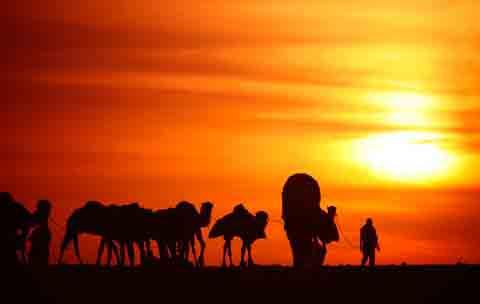
'The Journey to Mecca' is the first IMAX film about Islamic heritage and for the first time ever cameras were allowed to film during Hajj rituals with eighty Muslims from 24 countries being trained to utilize the special cameras, knowing that non-Muslims are not allowed to enter the holy Mecca and seeking permission from the 16 ministries that control different aspects of the Hajj, all for what became 10 minutes of film, Briefly, 'The Journey to Mecca' is the first film to receive an approval in the holy Kaaba and due to the fact that it's not allowed for non-Muslim technicians to enter Mecca we had to prepare four Islamic units to teach them how to use this special type of cameras and get 85 photography permits. With the help of hundreds of people we were able to cross thousands of miles between shooting in Morocco and Saudi Arabia during the hot weather and the sandstorms and other challenges with the researchers in order to get credible, accurate information which led us to shoot the longest caravan ever to appear onscreen in the world," said Sheikha Al-Zain.
Dima Al-Ansari, a producer with DDP who was on the set in Morocco, explained her own journey to complete this movie. "The number of people and of different nationalities that were there was more than I ever seen on any kind of set before and they took special care to ensure that all the Hajj footage was credible and all the information was correct, even in the Kaaba, the one we recreated, they made sure that it was exactly the same from the front and in the details.
She went on to explain the main difficulties that she and the crew faced and her opinion on why this movie was made. "The main difficulties that we face there was the language because there were very few who spoke Arabic in Morocco because their main languages were Moroccan and French and the film was made in two versions, English and Arabic; the original version was suppose to be in English but later they decided to make the Arabic version for the Gulf area.
I believe that this film was inspired by Ibn Battuta, who nobody knows much about. The original producers, Dominic Cunningham-Reid and Taran Davies, spent four years trying to make this movie happen; they went and lived in Saudi Arabia and they really worked hard to make this movie happen," Al-Ansari said. "They believed that this movie about Ibn Battuta and about Islam is needed in the West because the West does not understand about Islam. A third Canadian partner, Jonathan Parker from Toronto, also made this project possible.
'The Journey to Mecca' tells the story of Ibn Battuta (played by Chems Eddine Zinoun), a young scholar, who leaves Tangiers in 1325 on an epic and perilous journey, traveling alone from his home in Morocco to reach Mecca, some 3,000 miles to the east. Ibn Battuta is besieged by countless obstacles as he makes his way across the North African desert to Mecca. Along the route he meets an unlikely stranger, the Highwayman (played by Hassam Ghancy) who becomes his paid protector and eventual friend. During his travels he is attacked by bandits, dehydrated by thirst, rescued by Bedouins, and forced to retrace his route by a war-locked Red Sea.
Ibn Battuta would not return home for almost 30 years, travelling to over 40 countries and revisiting Mecca five more times to perform the Hajj. He would travel three times farther than Marco Polo and his legacy is one of the greatest travel journals ever recorded. A crater on the moon is named in his honor. Tragically, Chems Eddine Zinoun died in a car accident just after finishing the film and didn't have the chance to see it in its final form.
The movie, with its new techniques and breathtaking shots, transports the viewer to another era, allowing them to rethink their Islamic obligations. The $13 million required to make the 45-minute film was raised from private investors - Muslim and non-Muslim - in Morocco, France, the United States, Kuwait, Saudi Arabia and the United Arab Emirates. The film will open to the public on Thursday March 26th and will be shown at the Scientific Center for another six months.
For the first ten days, the film will be shown continuously for the first ten days from 10:30 am till 6:30 pm, with admission costing KD 3 for adults and KD 2 for children.