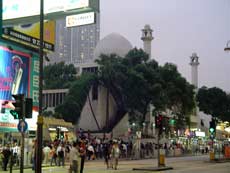
Ahmad Khan enters the small mosque in his South Korean town, he is always overwhelmed by the diverse accents, colors and nationalities surrounding him. "We have a few Koreans. We have Indonesians, Malaysians and Uzbeks. We have people from the US," Haseeb, who lives in the port city of Busan, told the Korea Herald on Monday, March 23.
"We have people from 12 to 14 countries."
In the mainly-Buddhist country, the Muslim community is marked by its rich racial and ethnic diversity.
The community has native Koreans, descendents of people who converted to Islam during the Korean War.
There are also tens of thousands of foreign workers and migrants from South and Southeast Asia and from across the world.
Haseeb, a businessman of Pakistani origin who has lived in South Korea for almost 10 years, notes that the Muslim community in his metropolitan city is growing.
Muslims, he added, are mulling the opening an Islamic school to accommodate their children.
"We're trying to open a small school in Busan," Haseeb stressed, adding that married couples who have kids want to give them an Islamic education.
According to the Korea Muslim Federation (KMF), established in 1967, there are about 120,000 to 130,000 Muslims living in South Korea, both natives and foreigners.
The majority of the population is made up of migrant workers from Pakistan and Bangladesh.
The number of native Korean Muslims is estimated at some 45,000.
Mosques
The one thing that brings the diverse Muslim community in South Korea closer is always the mosque, asserts Haseeb.
He notes that when he came to South Korea a decade ago, there were not a lot of mosques.
Now, there are mosques in various locations across the country.
"Now we have a lot of mosques in Korea."
The largest mosque is the Seoul Central Mosque in the Itaewon district of the capital.
Smaller mosques can be found in most of the country's major cities.
"We have more than 10 mosques in cities like Gwangju, Busan, Daegu," notes Haseeb.
He explains that for Muslims, mosques are not just a place to pray.
"The Friday prayer is to unite the people. After the prayer they can unite to make a better communityÂ…They can talk and they can listen," he maintains.
"For example, if someone is sick, they can arrange to go to the hospital -- or, if they find out that someone needs help, they can arrange to help."
Mosques also help those who are curious to know more about Islam.
Haseeb says mosques offer services and resources, including reading and audio materials, for people who want to learn more about Islam.
"They can get these things for free."